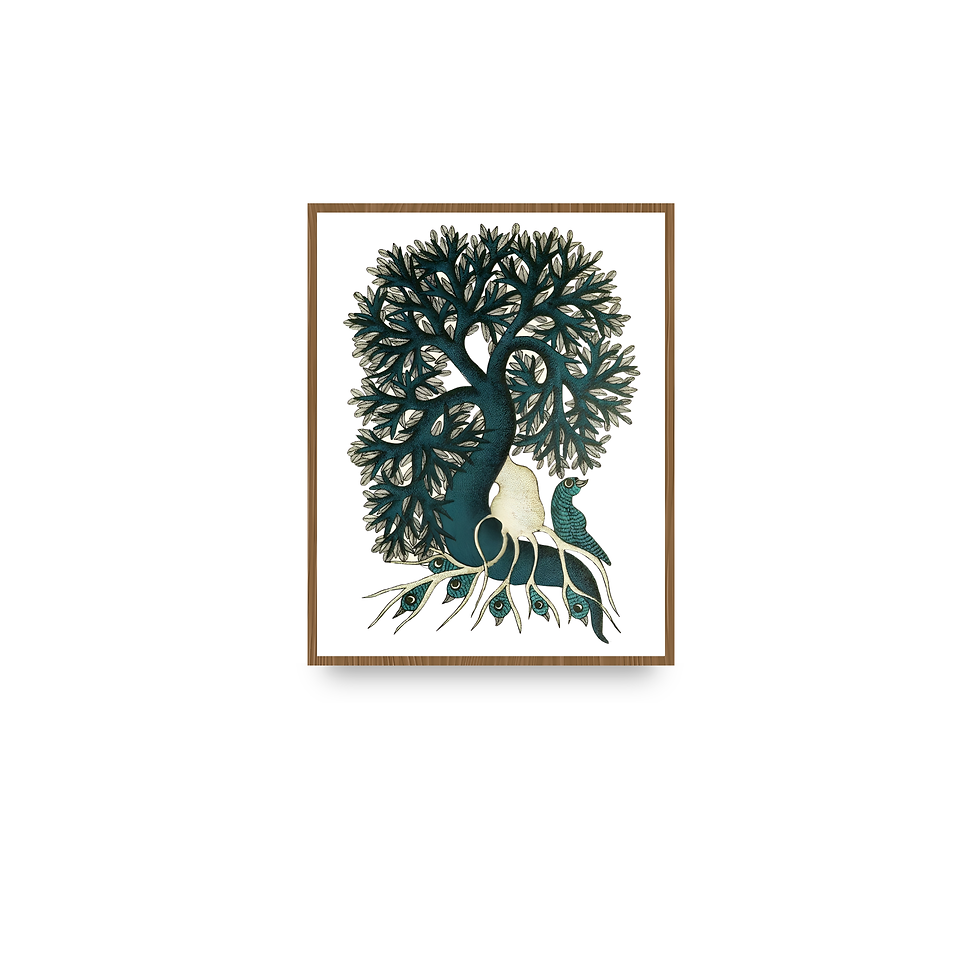
Gond Art
Rhythmic lines, dots, and dashes fill every form, traditionally in natural pigments on walls, now on paper and canvas.
Born amidst the forests and hills of central India, Gond art is practised primarily by communities across Madhya Pradesh, Chhattisgarh, and Maharashtra, reflecting a worldview where nature, memory, and spirituality are inseparable. The word "Gond" is believed to derive from the Dravidian "Kond," meaning green mountains, a name that speaks to the community's deep ecological roots.
Trees, rivers, animals, and celestial bodies are not merely motifs but carriers of ancestral story and wisdom. Visually, the tradition is defined by intricate lines, dots, and rhythmic patterns that animate every form – deer, tigers, peacocks, forests, and mythological scenes coexisting in expressive, interconnected worlds. A decisive turning point came in the 1980s when Jangarh Singh Shyam, from Patangarh village in Madhya Pradesh, brought international recognition to the form, giving rise to what is now known as Jangarh Kalam.
Today, Gond artists engage themes of migration, urbanisation, and ecological change, even as the tradition remains, at its core, a visual language for preserving oral histories, indigenous knowledge, and the enduring memory of a people deeply bound to the natural world.
.png)
Artist
Collection
Lorem Ipsum
Lorem Ipsum
India
Size
12 x 15 inches
Colour
Acrylic Colours
Material
Paper Sheet
Artist
Collection
Sunita Bhavor
Gond Art
Madhya Pradesh
Size
Colour
Material